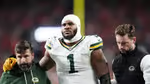
Marvin Harrison Jr. was traded from the Arizona Cardinals to the Houston Texans, a move that gives the Texans a highly drafted young receiver but also raises questions about cost and fit.
Deal mechanics, availability and immediate context
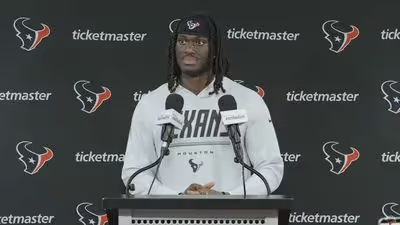
The teams completed the swap in mid-October. Yardbarker described the exchange as Houston sending a 2027 second-round pick and a sixth-round pick for Harrison while receiving a 2027 seventh-round selection; ESPN reported the teams structured the deal with Houston sending 2027 second- and seventh-round picks in exchange for Harrison and a 2027 sixth-round selection. The differing accounts reflect how the draft compensation was reported.
Harrison passed his physical on Monday and practiced with the Texans for the first time Wednesday. Houston coach DeMeco Ryans said Wednesday that Harrison will play Sunday against the Jacksonville Jaguars in London. Harrison, the No. 4 pick in the 2024 draft, joins a Texans team that is 1-4.
This season Harrison has five catches on 13 targets for 85 yards and a touchdown. The No. 4 pick in the 2024 NFL draft joins Houston with a career stat line of 108 receptions for 1,578 yards and 13 touchdowns in 33 games. Harrison said Wednesday the move is a "great" opportunity and that reuniting with his college quarterback C.J. makes the change appealing.
Why the move is being framed as a risky, short‑term bet
Commentary around the trade emphasizes risk: Yardbarker called the swap a risky one for Houston. The outlet noted Harrison’s recent expected value had fallen to roughly a day‑three pick, framing the price in draft capital as potentially steep if he doesn’t produce immediately.
The central tension for the Texans is timing. Yardbarker projected that if Harrison plays well, Houston can justify the cost — but that success would simply mean they paid a fair price rather than landing a bargain. Conversely, the outlet projected that underperformance would leave the Texans having overpaid and losing out on valuable draft resources.
Analysis in the reporting also flagged schematic concerns: adding a perimeter receiver of Harrison’s profile won’t automatically fix Houston’s broader offensive issues, particularly in the run game. Yardbarker argued the Texans’ rushing production still needs significant adjustment, which could limit Harrison’s ability to materially change the offense on his own.
Put simply, the trade is structured as a short‑term push. Yardbarker wrote that for the move to be worth it, Harrison needs to provide meaningful production immediately to help the Texans climb out of a 1-4 hole.
Harrison’s arrival offers a low-risk roster move in that he is on his rookie contract and available now, but the deeper question — whether the draft capital surrendered buys the Texans clear upside — will be answered on the field in London and beyond.