Disciplinary and financial fallout
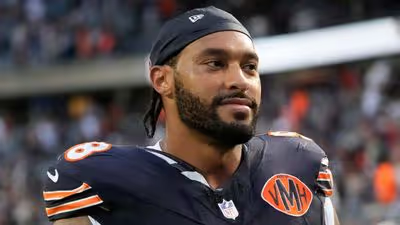
Montez Sweat was suspended two games by the NFL without pay after violating the league’s performance-enhancing substances policy, a ruling that landed Tuesday and takes immediate effect.
The suspension carries a direct financial hit. Sweat will forfeit $2.3 million of his 2026 salary, and the remainder of that $12.7 million is unsecured because the suspension voided future guarantees, leaving the Bears with less guaranteed payroll tied to Sweat for the rest of the season.
Those contract details shift the short-term ledger around Chicago’s defensive payroll and remove financial certainty that previously insulated Sweat’s 2026 earnings.
Immediate roster impact and on-field questions
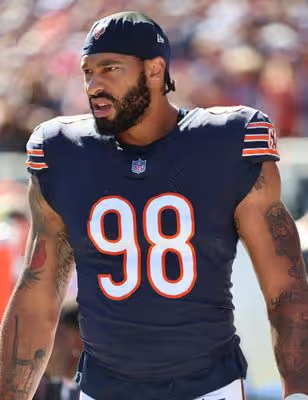
The two-game ban means the Chicago Bears will be without their leading edge presence for the next two games.
Absent Sweat, the Bears lose the primary outside-rushing piece who had been tasked with generating consistent pressure. That gap will force coordinator-level adjustments to how the team deploys its front and how much burden falls on interior rushers and blitz packages to produce disruption.
Yardbarker wrote that Sweat’s absence will be “eye-opening” for the defense and argued the situation should increase Chicago’s motivation to acquire another impact pass rusher. The outlet added that the recent suspension “kicked the door open” for the Bears to pursue a trade, noting the roster calculus and salary math around moving for reinforcements has become easier to stomach in light of the voided guarantees.
Those assessments are framed as opinion, but they reflect the immediate strategic choice the Bears face: rely on internal depth and schematic fixes for a two-game stretch or alter the roster via trade to replenish edge rush capability.
Strategic options and constraints
With Sweat sidelined, Chicago can pursue several paths, each with pros and cons. Elevating rotation players gives the staff continuity and avoids new acclimation issues, but it risks a drop-off in consistent pressure on opposing quarterbacks. Adjusting defensive calls to generate pressure from the interior or with linebacker blitzes can mitigate that drop but may expose the secondary in situations where the front can’t win one-on-one matchups.
Trading for an established pass rusher remains an option the franchise could explore. Yardbarker specifically suggested that the suspension should make the Bears more likely to engage in trade discussions and even floated the idea of bringing back a veteran edge presence, framing it as an opinion about what the team should consider. Any external acquisition would be weighed against the newly altered guarantee landscape on Sweat’s 2026 pay and standard trade costs — draft capital, contracts and player fits.
Financially, the immediate numbers provide breathing room in a narrow sense: the forfeited pay and unsecured guarantees change how Chicago might approach short-term moves, but they do not remove the need to match roster needs with affordable, available targets. The suspension’s voiding of guarantees also leaves longer-term leverage for the organization in future roster decisions tied to Sweat’s 2026 contract.
Short window, high stakes
Ultimately, the suspension creates a compact timeline. Montez Sweat’s two-game absence is short but occurs during a portion of the schedule where consistent pass-rush production can swing game plans. How the Chicago Bears choose to respond — internal adjustment, schematic shifts, or roster transactions — will reveal whether the club treats the suspension as a brief adversity to weather or an impetus for more significant change on the edge.
For now, the facts are clear: the NFL imposed a two-game, unpaid suspension; Sweat will forfeit $2.3 million of his 2026 salary; the remaining $12.7 million of that year’s pay is unsecured. Beyond those certainties, debate will mount over the best way to protect the defense during his absence and whether Chicago will pursue an external solution.