The Houston Texans completed a high‑profile midseason trade, acquiring Marvin Harrison Jr. from the Arizona Cardinals in exchange for a 2027 second‑ and seventh‑round pick while sending a 2027 sixth‑round pick back to Arizona. The deal reshapes Houston’s pass‑catching hierarchy, gives the newcomer a chance to reset away from the pressure that followed his No. 4 overall selection, and immediately alters how the Texans can deploy their offense.
Ryans’ bullish stance and what he expects from Marvin Harrison Jr.
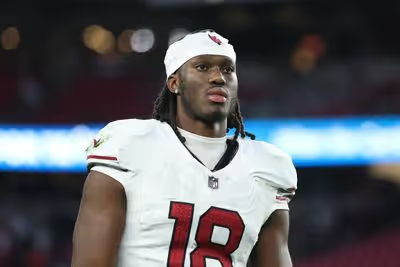
DeMeco Ryans announced the transaction during the Week 5 postgame presser and has been emphatic about the acquisition since. Ryans repeatedly stressed Harrison’s work ethic and attitude as the basis for his confidence that the player will assimilate quickly into Houston’s scheme.
“The thing that I’ve heard from a lot of people speaking about Marvin is he’s one of the hardest workers,” Ryans said. “That’s the common theme that I’ve heard from multiple people, how hard of a worker he is. I’m not concerned about him picking up the offense and what he can be able to run for us, the things that he’ll be able to do for us offensively. I’m not concerned about it because the kid is a hard worker. He has a great attitude. He’s fired up to be here. When you approach it that way, as he will, he’ll fit right in.”
Those remarks make Houston’s quick integration plan clear: coaches expect to lean on preparation and the player’s reported professionalism rather than significantly retooling the offense to accommodate a new focal point.
How the roster picture changes for Houston’s offense
Marvin Harrison Jr. arrives into a receiver group that is deeper and more established than the one he left. This will be the first time since his freshman year that he won’t be the unquestioned No. 1 option, easing the performance spotlight he carried as a top‑of‑roster draft pick.
Houston already features a two‑time Pro Bowler in Nico Collins and added Kayshon Boutte before the season. Tank Dell is expected to return soon, and Jaylin Noel remains part of the offensive mix. That collection of targets gives the Texans the flexibility to rotate personnel, create mismatches across alignments and limit the immediate burden on their newest arrival.
Practically, adding Marvin Harrison Jr. gives the Texans a different kind of perimeter option to pair with the existing corps. Ryans pointed to the player’s ability to step into routes and handle responsibilities on short notice — a combination of skill and temperament that the staff believes will make him a reliable target in critical situations. The team also sees him as a complementary presence who can settle into role‑specific snaps without being forced into the primary role he held earlier in his career.
Short‑term timeline and strategic effects on playcalling
Houston’s schedule presents a rapid turnaround: the Texans face the Jacksonville Jaguars in London on Sunday, which would be a tight window for the newcomer to make his debut. It is plausible that he sees his first snaps for Houston the following week when the team returns home to face the New York Giants.
Even if his on‑field impact comes in gradual stages, the trade gives Houston new schematic options. The coaching staff can spread targets across the roster, exploit favorable matchups and deploy situational packages that pair the newcomer alongside established veterans. That should reduce the need to manufacture a single dominant target for every passing concept and allow the offense to emphasize spacing, route diversity and red‑zone efficiency.
Ryans’ public confidence about the player picking up the system puts the emphasis on short‑term readiness rather than long ramp‑up time. Whether the player is available immediately or phased in over multiple weeks, opponents must now account for one more reliable option in Houston’s route tree.
The trade also carries implications for future roster planning. Exchanging mid‑round draft capital for a proven asset signals the Texans’ willingness to prioritize present‑day offensive flexibility over longer‑term draft accumulation. If Marvin Harrison Jr. lands into the intended complementary role and meshes with the existing group, the cost could be justified by a more efficient passing attack and deeper receiver rotation across the season.
For Marvin Harrison Jr., the move provides an opportunity to reset expectations. No longer the singular focal point he was projected to be coming into the league, he enters an environment with established peers and an organizational message emphasizing fit and effort over immediate reinvention.
How quickly that vision translates to production will come down to practice reps, how the staff deploys him in game plans, and whether the early timetable allows for a smooth debut. But with the trade official and Ryans publicly endorsing the fit, the Texans have made a decisive change to their offensive profile — one that could meaningfully alter both their short‑term game plans and the franchise’s path through the rest of the season.